Using spelunker to study JWST Time Series Observations (TSOs)
Authors: Néstor Espinoza (nespinoza@stsci.edu), Derod Deal (dealderod@ufl.edu) | Last update: Apr 16, 2024
Program version: ver. 1.1.9
JWST Time Series Observations (TSOs) are multi-integration exposures
typically targeted at exploring time-varying phenomena: from
exoplanetary transits to accreting material in distant objects.
Guidestar data such as the one spelunker can query can become very
helpful at exploring this data; this tutorial provides an introduction
on how to use the spelunker products to analyze it.
1. The case of HAT-P-14 b NIRISS/SOSS observations
The first dataset we will be analyzing below comes from an exoplanetary transit obtained by Program ID 1541 (PI: Espinoza). This dataset was already introduced in Albert et al. (2023), and consisted of a transit observation of the exoplanet HAT-P-14 b, which was used to test the sensitivity and stability of the NIRISS/SOSS instrument during commissioning.
To start the analysis, let’s load some libraries:
import numpy as np
import matplotlib.pyplot as plt

import spelunker
spelunker.__version__
'1.1.9'
1.1 Exploring the transit event of HAT-P-14 b
Let’s first load and plot the NIRISS/SOSS HAT-P-14 b dataset. This is a
lightcurve that was obtained using the transitspectroscopy pipeline
(Espinoza, 2022,
and which can be obtained from the spelunker Github repository
here;
we extract the time, flux and error on the flux from this data file:
t, f, ferr = np.loadtxt('data/hp14_lightcurve.dat', unpack = True, usecols = (0,1,2))
tstart = t[0]
time_since_start = (t-tstart)*24

plt.figure(figsize=(10,4))

plt.errorbar(time_since_start, f, ferr, fmt = '.',
                         ms = 1, mfc = 'black', mec = 'black',
                         elinewidth = 1, ecolor = 'black')

plt.title('Exoplanet transit of HAT-P-14 b with NIRISS/SOSS', fontsize = 18)
plt.xlabel('Time since exposure start (hours)', fontsize = 18)
plt.ylabel('Relative flux', fontsize = 18)

plt.xticks(fontsize=16)
plt.yticks(fontsize=16)

plt.xlim(np.min(time_since_start), np.max(time_since_start))
plt.show()
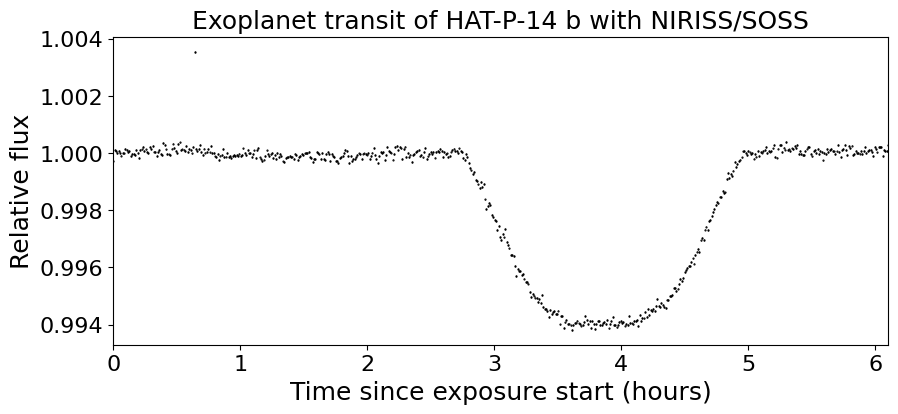
All right. This time-series shows a nice transit event from about hour 2.75 since exposure start, all the way until about hour 5. Aside from the transit event, however, there is an evident oscillation in the data, which is evident if we do a zoom to the first three hours of data:
tstart = t[0]
time_since_start = (t-tstart)*24

plt.figure(figsize=(10,4))

plt.plot(time_since_start, (f-1)*1e6, color = 'black')
plt.errorbar(time_since_start, (f-1)*1e6, ferr*1e6, fmt = '.',
                         ms = 1, mfc = 'black', mec = 'black',
                         elinewidth = 1, ecolor = 'black')

plt.title('Exoplanet transit of HAT-P-14 b with NIRISS/SOSS (zoom)', fontsize = 18)
plt.xlabel('Time since exposure start (hours)', fontsize = 18)
plt.ylabel('Relative flux - 1 (ppm)', fontsize = 18)

plt.xticks(fontsize=16)
plt.yticks(fontsize=16)

plt.xlim(np.min(time_since_start), 3)
plt.ylim(-500, 500)

plt.show()
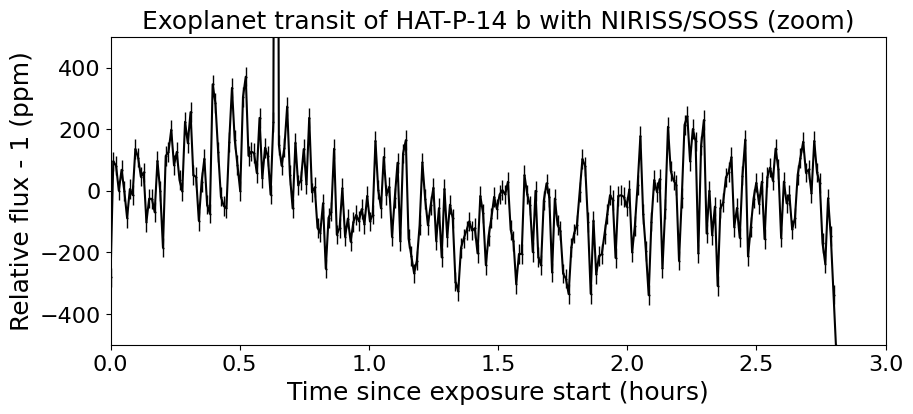
The light curve has at least two oscillation patterns. One is a long-term one, on which the light curve seems to rise at about hour 0.5 after start, then go down until about hour 1, and then oscillate up again at about hour 3. The other is a short-frequency oscillation, with a period of about ~5 minutes. The amplitude of those oscillations is small — around 200 ppm.
Big question is: are those oscillations really happening on HAT-P-14 (the star)? Or is this an instrumental effect? Let’s now explore the guidestar data to find this out.
1.2 Exploring the guidestar data of PID 1541
Let’s use spelunker to load the guidestar data for this Program
ID/observation/visit. To get these values, one can explore the Program
Information webpage for the program
here
and click on the “Visit Status Information”
page
that will present this data to a user. In our case, this dataset
corresponds to PID 1541, observation number 1 and visit 1:
spk = spelunker.load(pid=1541, obs_num='1', visit='1', save=True)
Current working directory for spelunker: /Users/nespinoza/github/JWST-FGS-Spelunker/notebooks/spelunker_outputs

Connecting with astroquery...
Let’s check the time-series of the guidestar data:
plt.figure(figsize=(10,4))

fg_time_since_start = (spk.fg_time + 2400000.5 - tstart) * 24

plt.plot(fg_time_since_start, spk.fg_flux / np.nanmedian( spk.fg_flux ) , color = 'tomato')

plt.title('Guidestar flux for PID 1541, visit 1, observation 1', fontsize = 18)
plt.xlabel('Time since exposure start (hours)', fontsize = 18)
plt.ylabel('Relative flux', fontsize = 18)

plt.ylim(0.5,1.5)
plt.xticks(fontsize=16)
plt.yticks(fontsize=16)

plt.xlim(np.min(time_since_start), np.max(time_since_start))
plt.show()
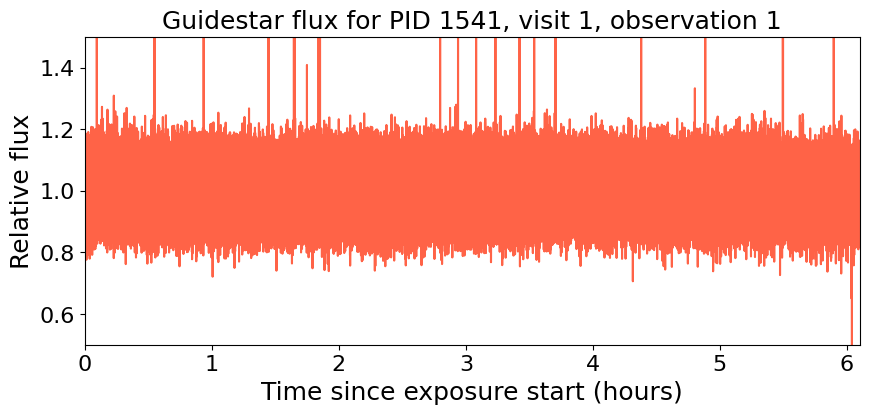
The raw photometry from the guidestar varies by a lot more than our target star due to random noise in the very high cadence JWST FGS data. Let’s bin the FGS time-series to the same cadence as the science time-series, which will allow us to see more structure in the data. To this end, let’s write a function that does this:
def bin_fgs_to_science(tscience, tfgs, ffgs):
    """
    This function bins an FGS time-series defined by the times `tfgs` and fluxes `ffgs`, to times `tscience`.
    The function assumes that (1) `tscience` are times obtained at pseudo-regular intervals (i.e., that times
    on `tscience` next to each other are similar), and that (2) `tscience` is ordered in chronological order.
    """

    nscience = len(tscience)
    binned_fgs = np.zeros( nscience )
    binned_fgs_err = np.zeros( nscience )
    for i in range( nscience ):

        if i == 0:

            dt = tscience[1] - tscience[0]

        elif i == nscience - 1:

            dt = tscience[-1] - tscience[-2]

        else:

            dt1 = tscience[i] - tscience[i-1]
            dt2 = tscience[i+1] - tscience[i]
            dt = ( dt1 + dt2 ) * 0.5

        idx = np.where( np.abs(tscience[i] - tfgs) < 0.5*dt )[0]
        binned_fgs[i] = np.mean( ffgs[idx] )
        binned_fgs_err[i] = np.sqrt( np.var( ffgs[idx] ) ) / np.sqrt( len(idx) )

    return binned_fgs, binned_fgs_err
fbin, fbinerr = bin_fgs_to_science(time_since_start, fg_time_since_start, spk.fg_flux / np.nanmedian( spk.fg_flux ))
plt.figure(figsize=(10,4))

plt.errorbar(time_since_start, (fbin-1)*1e6, fbinerr*1e6, color = 'tomato')

plt.title('(Binned) GS flux for PID 1541, visit 1, observation 1', fontsize = 18)
plt.xlabel('Time since exposure start (hours)', fontsize = 18)
plt.ylabel('Relative flux (ppm)', fontsize = 18)

plt.ylim(1.0-0.05,1+0.05)
plt.xticks(fontsize=16)
plt.yticks(fontsize=16)

plt.ylim(-10000, 10000)
plt.xlim(np.min(time_since_start), 3)
plt.show()
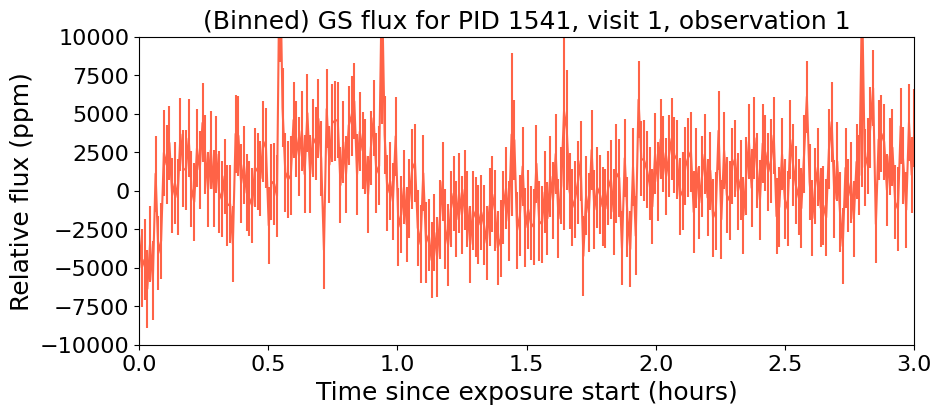
This actually resembles the science time-series quite nicely, although at a different amplitude. Let’s plot both on the same figure:
tstart = t[0]
time_since_start = (t-tstart)*24

plt.figure(figsize=(10,4))

plt.plot(time_since_start, (f-1)*1e6, color = 'black', label = 'NIRISS/SOSS TSO')

plt.plot(time_since_start, (fbin-1)*1e6*0.05, color = 'tomato', label = r'FGS Guidestar Flux TSO $\times$ 0.05')

plt.legend()
plt.xlabel('Time since exposure start (hours)', fontsize = 18)
plt.ylabel('Relative flux - 1 (ppm)', fontsize = 18)

plt.xticks(fontsize=16)
plt.yticks(fontsize=16)

plt.xlim(np.min(time_since_start), 3)
plt.ylim(-500, 500)

plt.show()
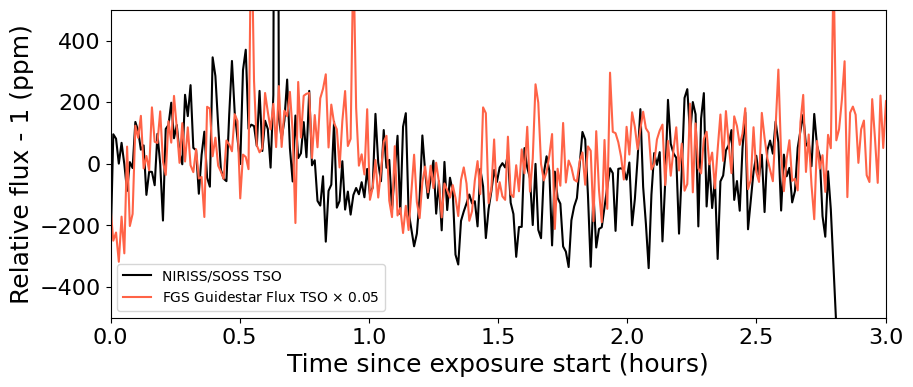
Remarkable! The amplitude might need some tweaking, but it seems this can, indeed, help track some lightcurve variations. Let’s look next at other features that could be correlated with instrumental systematics.
1.3 More, more! Correlating PSF Guidestar properties to JWST TSOs
spelunker can also fit Gaussians to each of the 2D FG frames, and
extract more precise parameters than the simple “crude” photometry
described above. This takes a while (a few minutes), so we need to be a
bit patient. Note there’s a series of messages that appear below — these
come from ray, a multi-processing library spelunker uses in the
background. None of the errors are important for our particular
application.
spk.gauss2d_fit(ncpus=4)
results = {}

for key in list(spk.gaussfit_results.keys()):

    results[key], _ = bin_fgs_to_science(time_since_start,
                                         fg_time_since_start,
                                         spk.gaussfit_results[key].value)
print(results.keys())
dict_keys(['amplitude', 'x_mean', 'y_mean', 'x_stddev', 'y_stddev', 'theta', 'offset'])
Let’s plot all of those parameters for the entire duration of the TSO:
for key in list(results.keys()):

    plt.figure(figsize=(10,4))

    median = np.nanmedian(results[key])
    std = np.nanmedian(np.abs(results[key] - median)) * 1.4826
    plt.plot(time_since_start, results[key], color = 'tomato')

    plt.title(key+' for FGS 2D Gaussian Fit', fontsize = 18)
    plt.xlabel('Time since exposure start (hours)', fontsize = 18)
    plt.ylabel(key, fontsize = 18)

    plt.xticks(fontsize=16)
    plt.yticks(fontsize=16)

    plt.xlim(np.min(time_since_start), np.max(time_since_start))
    plt.ylim(median-3*std,median+5*std)

plt.show()
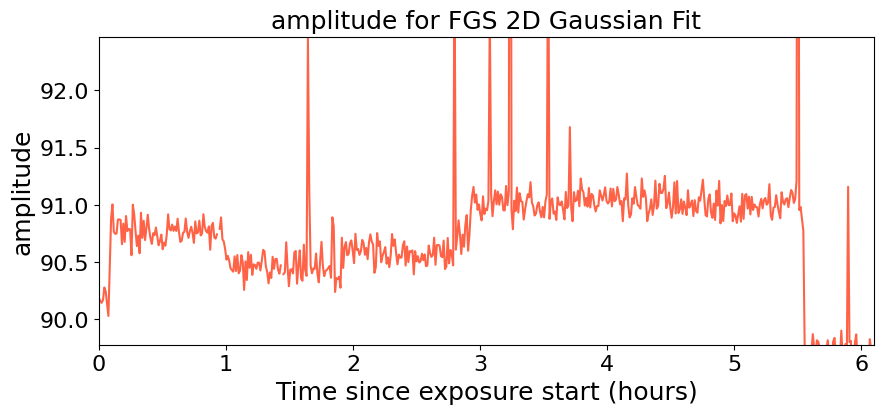
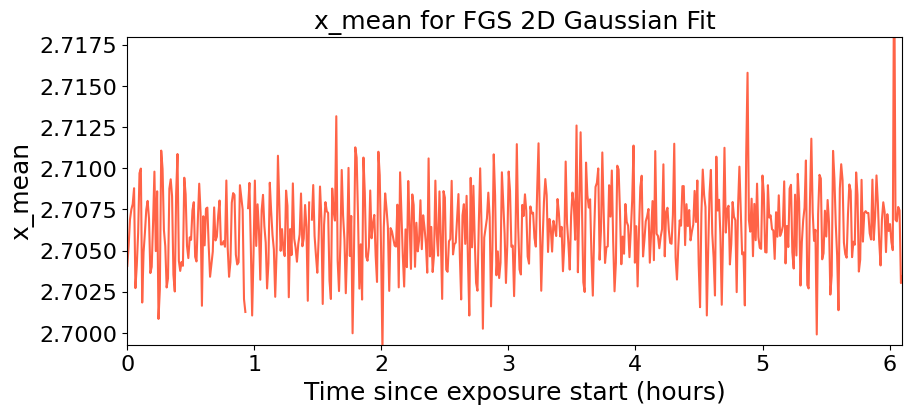
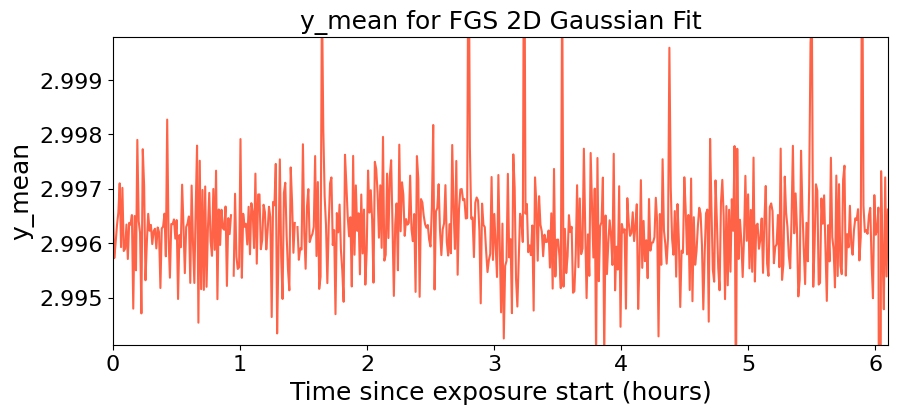
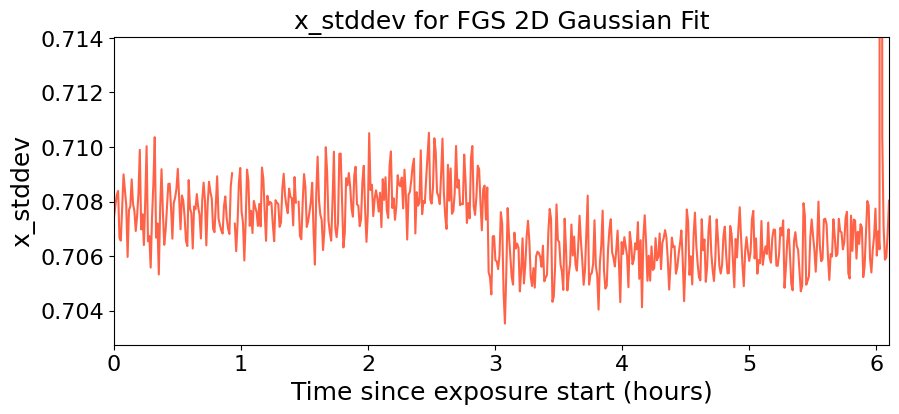
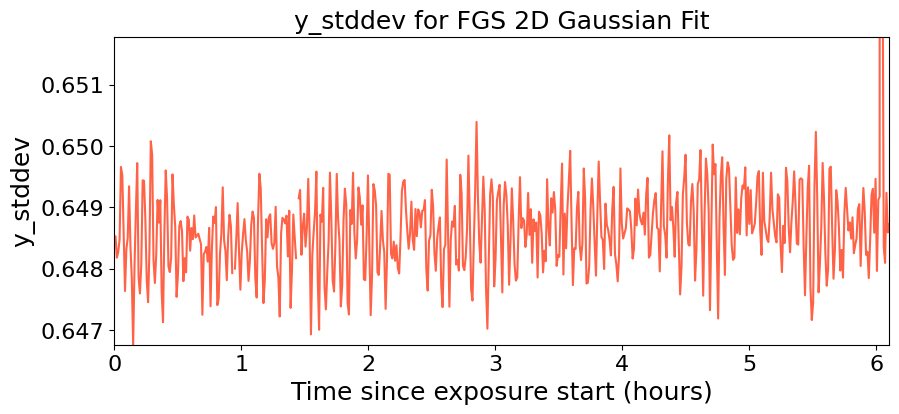
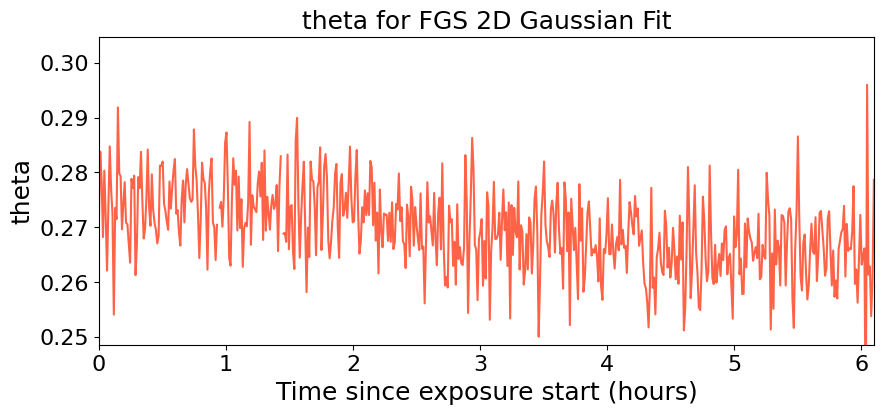
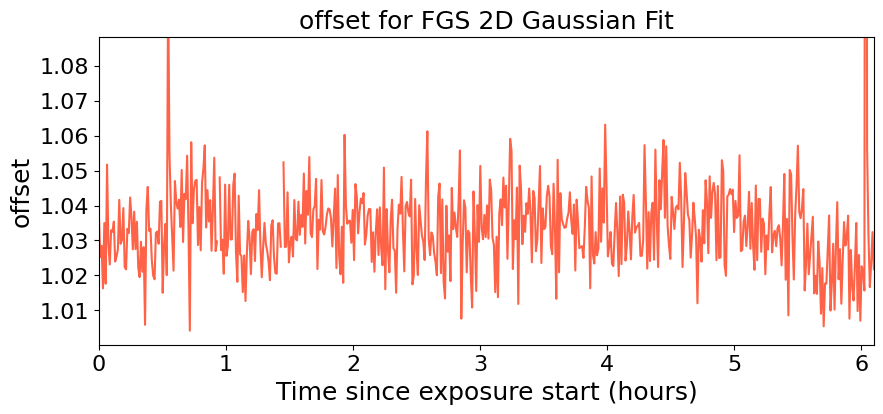
Neat! Many things to unpack.
First, note how the position in X (x_mean) and the standard
deviation in this direction (x_stddev), together with the standard
deviation on the y-direction (y_stddev) and the rotation angle of
the gaussian (theta) all oscillate in short frequency, in concert
with the science TSO. Let’s compare those time-series on top of the
science TSO for the first three hours. To do this, let’s create a helper
function that standarizes our regressors:
def standarize(x):

    median = np.nanmedian(x)
    std = np.nanmedian(np.abs(x - median)) * 1.4826

    return ( x - median ) / std
variable = 'x_mean'

plt.figure(figsize=(10,4))

plt.plot(time_since_start, (f-1)*1e6, color = 'black', label = 'NIRISS/SOSS TSO')

plt.plot(time_since_start, standarize(results[variable])*100*(-1),
         color = 'tomato', label = r'FGS '+variable+r' $\times$ -100')

plt.legend()
plt.xlabel('Time since exposure start (hours)', fontsize = 18)
plt.ylabel('Relative flux - 1 (ppm)', fontsize = 18)

plt.xticks(fontsize=16)
plt.yticks(fontsize=16)

plt.xlim(np.min(time_since_start), 3)
plt.ylim(-500, 500)

plt.show()
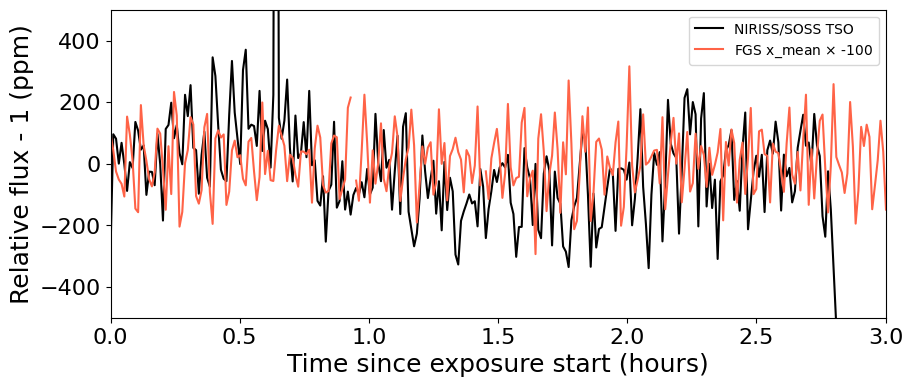
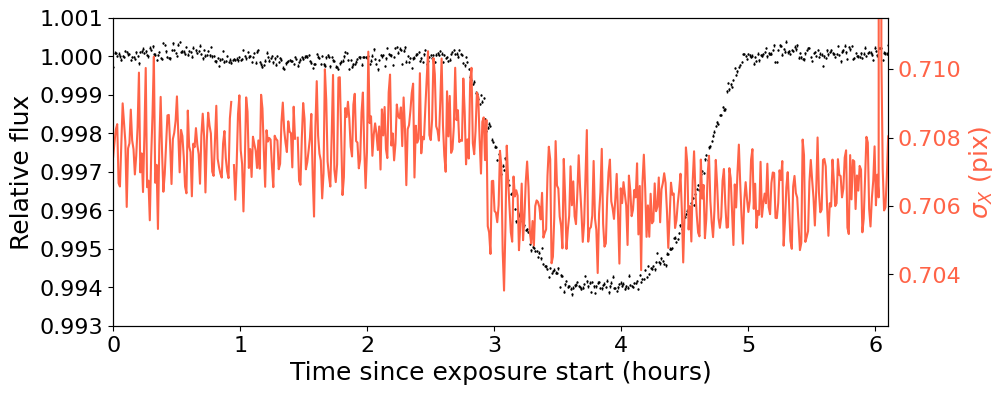
Very nice correlation between variables! Also, note how the x-standard deviation detects what appears to be a small “tilt event” — un-commanded changes of the primary mirror segments, believed to happen due to release of stored stresses in the mirror (Lajoie et al., 2023) — and which manifest as abrupt PSF position and shape changes:
plt.figure(figsize=(10,4))

plt.plot(time_since_start, results['x_stddev'], color = 'tomato')

plt.title('X-standard deviation for FGS 2D Gaussian Fit', fontsize = 18)
plt.xlabel('Time since exposure start (hours)', fontsize = 18)
plt.ylabel('$\sigma_X$ (pix)', fontsize = 18)

plt.xticks(fontsize=16)
plt.yticks(fontsize=16)
plt.ylim(0.7025,0.7115)
plt.xlim(np.min(time_since_start), np.max(time_since_start))

plt.show()
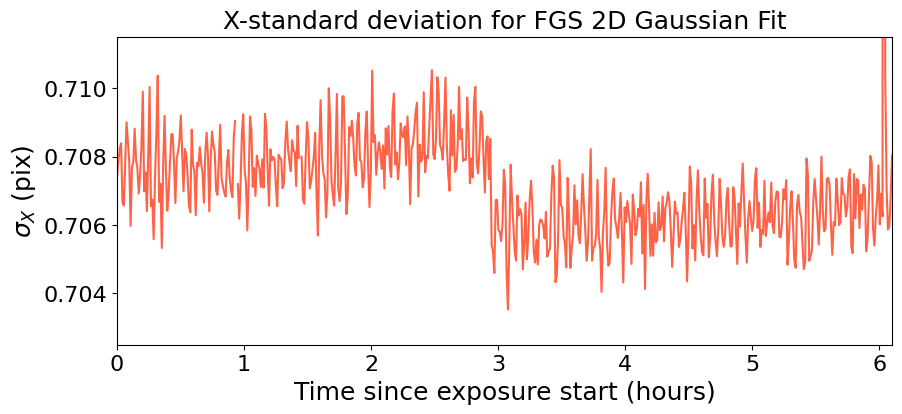
Seeing this from the actual TSO is quite difficult, because the tilt event happened just during ingress:
plt.figure(figsize=(10,4))

plt.errorbar(time_since_start, f, ferr, fmt = '.',
                         ms = 1, mfc = 'black', mec = 'black',
                         elinewidth = 1, ecolor = 'black')

plt.xlabel('Time since exposure start (hours)', fontsize = 18)
plt.ylabel('Relative flux', fontsize = 18)


plt.xlim(np.min(time_since_start), np.max(time_since_start))
plt.ylim(0.993, 1.001)

plt.xticks(fontsize=16)
plt.yticks(fontsize=16)

plt.twinx()
variable = 'x_stddev'
plt.plot(time_since_start, results[variable],
         color = 'tomato', label = r'FGS '+variable)

plt.ylim(0.7025,0.7115)

plt.ylabel('$\sigma_X$ (pix)', fontsize = 18, color = 'tomato')

plt.yticks(fontsize=16, color = 'tomato')

plt.show()
To showcase further the beauty of spelunker as a TSO event detector,
let’s analyze one more dataset on which the tilt event is obvious: the
ERS observations of WASP-39 b with NIRSpec/G395H.
2. The case of WASP-39 b NIRSpec/G395H observations
Let’s repeat the analysis for the transit WASP-39 b with NIRSpec/G395H.
Let’s study the NRS1 lightcurve presented in Alderson et
al. (2023). This
lightcurve, as the one for HAT-P-14 b introduced above, was also
generated using the transitspectroscopy pipeline — we have uploaded
this to this Github repository as well
here.
We extract the time, flux and error on the flux:
t, f, ferr = np.loadtxt('data/w39_lightcurve.dat', unpack = True, usecols = (0,1,2))
tstart = t[0]
time_since_start = (t-tstart)*24

plt.figure(figsize=(10,4))

plt.errorbar(time_since_start, f, ferr, fmt = '.',
                         ms = 1, mfc = 'black', mec = 'black',
                         elinewidth = 1, ecolor = 'black')

plt.title('Exoplanet transit of WASP-39b with NIRSpec/G395H', fontsize = 18)
plt.xlabel('Time since exposure start (hours)', fontsize = 18)
plt.ylabel('Relative flux', fontsize = 18)

plt.xticks(fontsize=16)
plt.yticks(fontsize=16)

plt.xlim(np.min(time_since_start), np.max(time_since_start))

plt.show()
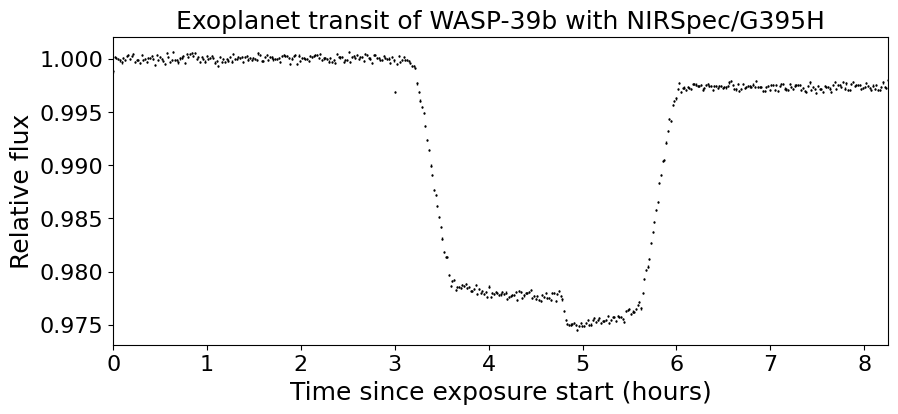
Note that break in the transit light curve? That’s a tilt event. One
that spelunker can also detect! Let’s run the spelunker magic
for this program, which is PID 1366 (PI: Batalha, co-PI: Bean,
Stevenson).
This, in particular, is observation number 3, visit 1:
spk = spelunker.load(pid=1366, obs_num='3', visit='1', save=True)
Current working directory for spelunker: /Users/nespinoza/github/JWST-FGS-Spelunker/notebooks/spelunker_outputs

Connecting with astroquery...
Let’s explore the guidestar (binned) photometry:
fg_time_since_start = (spk.fg_time + 2400000.5 - tstart) * 24
fbin, fbinerr = bin_fgs_to_science(time_since_start, fg_time_since_start, spk.fg_flux / np.nanmedian( spk.fg_flux ))
plt.figure(figsize=(10,4))

plt.errorbar(time_since_start, (fbin-1)*1e6, fbinerr*1e6, color = 'tomato')

plt.title('(Binned) GS flux for PID 1541, visit 1, observation 1', fontsize = 18)
plt.xlabel('Time since exposure start (hours)', fontsize = 18)
plt.ylabel('Relative flux (ppm)', fontsize = 18)

plt.xticks(fontsize=16)
plt.yticks(fontsize=16)

plt.xlim(np.min(time_since_start), np.max(time_since_start))

plt.show()
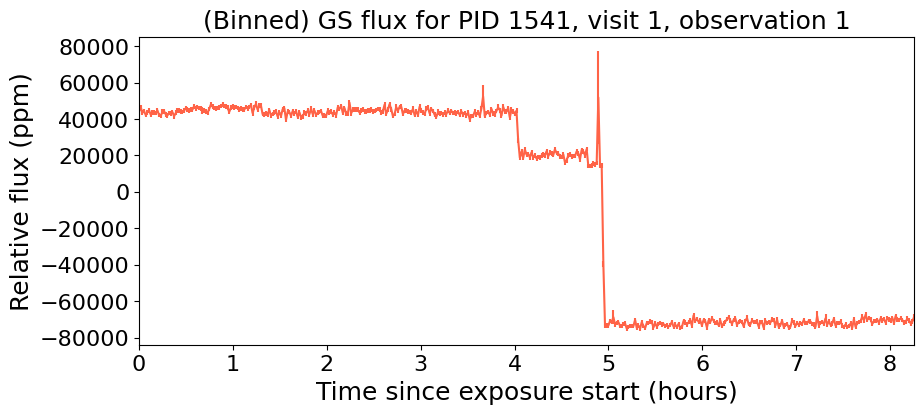
Oh my. It’s not only one, but perhaps…two, three tilt events?:
tstart = t[0]
time_since_start = (t-tstart)*24

plt.figure(figsize=(10,4))

plt.errorbar(time_since_start, f, ferr, fmt = '.',
                         ms = 1, mfc = 'black', mec = 'black',
                         elinewidth = 1, ecolor = 'black')

plt.xlabel('Time since exposure start (hours)', fontsize = 18)
plt.ylabel('Relative flux', fontsize = 18)

plt.xticks(fontsize=16)
plt.yticks(fontsize=16)

plt.xlim(np.min(time_since_start), np.max(time_since_start))

plt.twinx()

plt.errorbar(time_since_start, (fbin-1)*1e6, fbinerr*1e6, color = 'tomato')

plt.ylabel('Relative flux (FGS)', fontsize = 18, color = 'tomato')

plt.xticks(fontsize=16)
plt.yticks(fontsize=16, color = 'tomato')

plt.show()
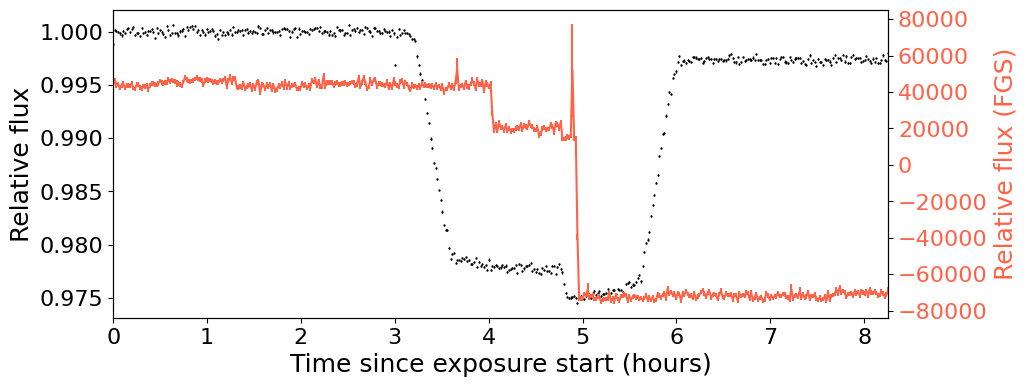
Very interesting. Let’s explore the gaussian fits to the data:
spk.gauss2d_fit(ncpus=4)
Let’s bin this to the science time-stamps:
results = {}

for key in list(spk.gaussfit_results.keys()):

    results[key], _ = bin_fgs_to_science(time_since_start,
                                         fg_time_since_start,
                                         spk.gaussfit_results[key].value)
Let’s go right away to the X standard deviation:
plt.figure(figsize=(10,4))

plt.errorbar(time_since_start, f, ferr, fmt = '.',
                         ms = 1, mfc = 'black', mec = 'black',
                         elinewidth = 1, ecolor = 'black')

plt.xlabel('Time since exposure start (hours)', fontsize = 18)
plt.ylabel('Relative flux', fontsize = 18)


plt.xlim(np.min(time_since_start), np.max(time_since_start))

plt.xticks(fontsize=16)
plt.yticks(fontsize=16)

plt.twinx()
variable = 'x_stddev'
plt.plot(time_since_start, results[variable],
         color = 'tomato', label = r'FGS '+variable)

plt.ylabel('$\sigma_X$ (pix)', fontsize = 18, color = 'tomato')

plt.yticks(fontsize=16, color = 'tomato')

plt.show()
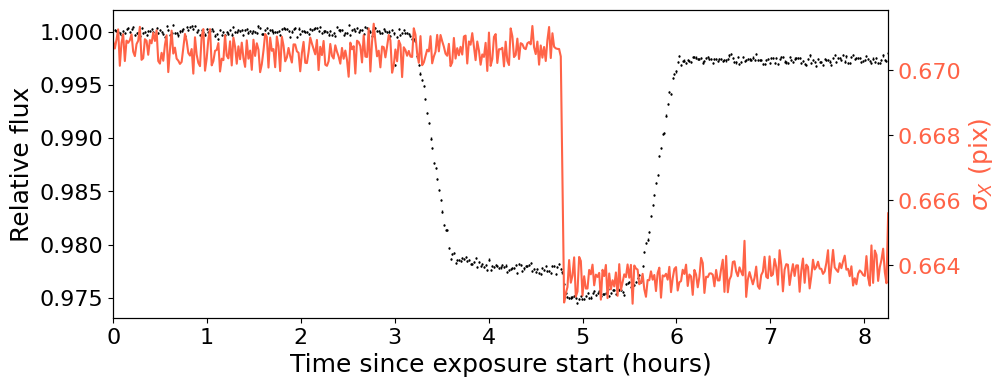
Very interesting! The “tilt” event is beautifully detected by the guidestar data. Best of all, we can see the event at any resolution we want thanks to it, because the FGS data has much higher tempoeral resolution that the TSO data itself. Let’s write a function that can bin the data at any temporal resolution so we can see this in action:
def bin_data(x,y,n_bin):

    x_bins = []
    y_bins = []
    y_err_bins = []

    for i in range(0,len(x),n_bin):

        x_bins.append(np.median(x[i:i+n_bin-1]))
        y_bins.append(np.median(y[i:i+n_bin-1]))
        y_err_bins.append(np.sqrt(np.var(y[i:i+n_bin-1]))/np.sqrt(len(y[i:i+n_bin-1])))

    return np.array(x_bins),np.array(y_bins),np.array(y_err_bins)
plt.figure(figsize=(10,4))

plt.errorbar(time_since_start, f, ferr, fmt = 'o',
                         ms = 5, mfc = 'black', mec = 'black',
                         elinewidth = 1, ecolor = 'black')

plt.xlabel('Time since exposure start (hours)', fontsize = 18)
plt.ylabel('Relative flux', fontsize = 18)


plt.xlim(4.5,5.0)
plt.ylim(0.973, 0.980)

plt.xticks(fontsize=16)
plt.yticks(fontsize=16)

plt.twinx()

variable = 'x_stddev'
plt.plot(time_since_start, results[variable],
         color = 'tomato', label = r'FGS '+variable)

tbin, ybin, _ = bin_data((spk.fg_time + 2400000.5 - tstart) * 24, spk.gaussfit_results[variable].value, n_bin = 300)
plt.plot(tbin, ybin, '.-',
         color = 'red', alpha = 0.3)

plt.plot(time_since_start, results[variable],
         'o', color = 'tomato')

plt.xlim(4.5,5.0)
plt.ylim(0.66,0.675)

plt.ylabel('$\sigma_X$ (pix)', fontsize = 18, color = 'tomato')

plt.yticks(fontsize=16, color = 'tomato')

plt.show()
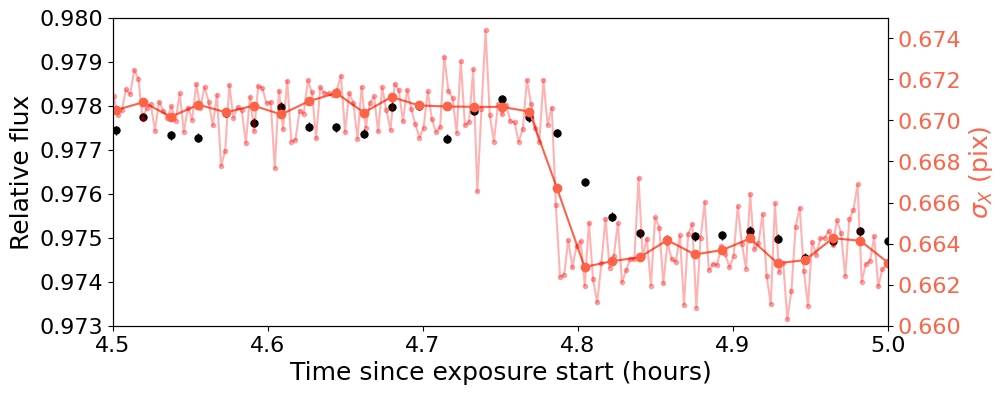
Interestingly, in this case, the Y-standard deviation samples the event even better, when considering the amplitude of the “jump” in this time series to the overall scatter of the time-series for the Y-standard deviation itself, \(\sigma_Y\):
plt.figure(figsize=(10,4))

plt.errorbar(time_since_start, f, ferr, fmt = 'o',
                         ms = 5, mfc = 'black', mec = 'black',
                         elinewidth = 1, ecolor = 'black')

plt.xlabel('Time since exposure start (hours)', fontsize = 18)
plt.ylabel('Relative flux', fontsize = 18)


plt.xlim(4.5,5.0)
plt.ylim(0.973, 0.980)

plt.xticks(fontsize=16)
plt.yticks(fontsize=16)

plt.twinx()

variable = 'y_stddev'
plt.plot(time_since_start, results[variable],
         color = 'cornflowerblue', label = r'FGS '+variable)

tbin, ybin, _ = bin_data((spk.fg_time + 2400000.5 - tstart) * 24, spk.gaussfit_results[variable].value, n_bin = 300)
plt.plot(tbin, ybin, '.-',
         color = 'cornflowerblue', alpha = 0.3)

plt.plot(time_since_start, results[variable],
         'o', color = 'cornflowerblue')

plt.xlim(4.5,5.0)
plt.ylim(0.58,0.63)

plt.ylabel('$\sigma_Y$ (pix)', fontsize = 18, color = 'cornflowerblue')

plt.yticks(fontsize=16, color = 'cornflowerblue')

plt.show()
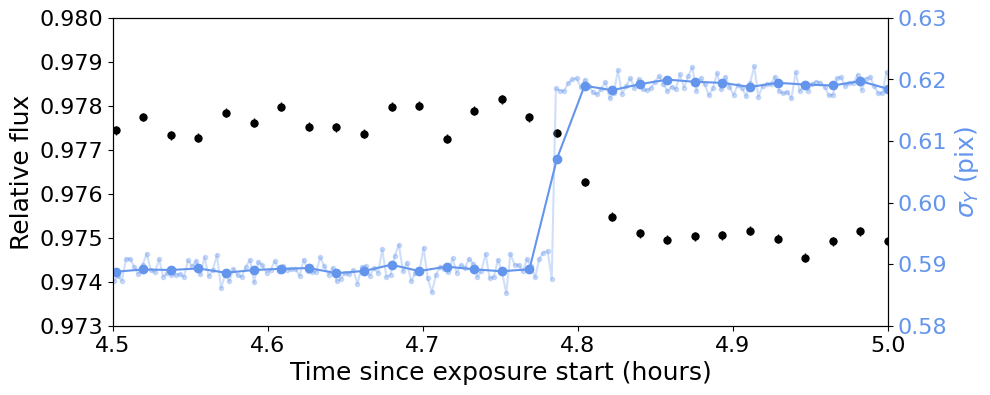
It is very interesting how while the change of the PSF in the guidestar is almost instantaneous, the PSF change in the TSO is slightly smoother. This smooth behavior is actually quite nicely tracked by the mean positions:
plt.figure(figsize=(10,4))

plt.errorbar(time_since_start, f, ferr, fmt = 'o',
                         ms = 5, mfc = 'black', mec = 'black',
                         elinewidth = 1, ecolor = 'black')

plt.xlabel('Time since exposure start (hours)', fontsize = 18)
plt.ylabel('Relative flux', fontsize = 18)


plt.xlim(4.5,5.0)
plt.ylim(0.973, 0.980)

plt.xticks(fontsize=16)
plt.yticks(fontsize=16)

plt.twinx()

variable = 'y_mean'
plt.plot(time_since_start, results[variable],
         color = 'cornflowerblue', label = r'FGS '+variable)

tbin, ybin, _ = bin_data((spk.fg_time + 2400000.5 - tstart) * 24, spk.gaussfit_results[variable].value, n_bin = 300)
plt.plot(tbin, ybin, '.-',
         color = 'cornflowerblue', alpha = 0.3)

plt.plot(time_since_start, results[variable],
         'o', color = 'cornflowerblue')

plt.xlim(4.5,5.0)
plt.ylim(3.71,3.74)

plt.ylabel('$Y$ (pix)', fontsize = 18, color = 'cornflowerblue')

plt.yticks(fontsize=16, color = 'cornflowerblue')

plt.show()
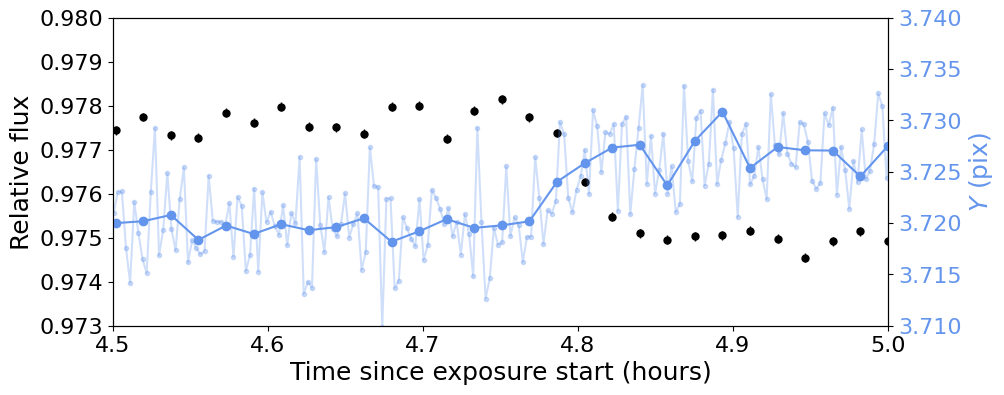
It is this availability of derived products from the FGS frames what makes this data so rich and powerful when compared against science data. In particular, the different ways in which different FGS parameters might correlate with the science data might be useful to decorrelate the science time-series itself, which might help correcting for events such as the ones showcased above.